


Activating Auditory Hair Cells!
Awakening Weakened Hearing
Hwalcheong care (our tinnitus and hearing loss care)
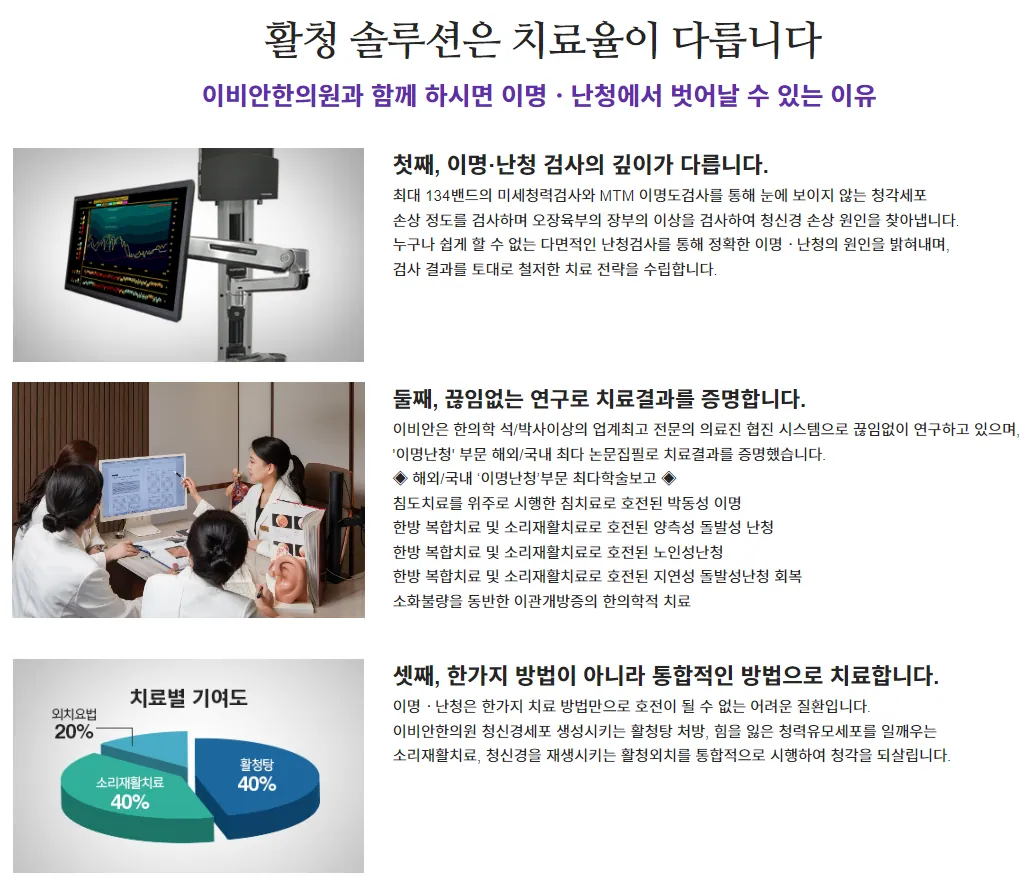
Different right from the evaluation phase!
Different in treatment results!


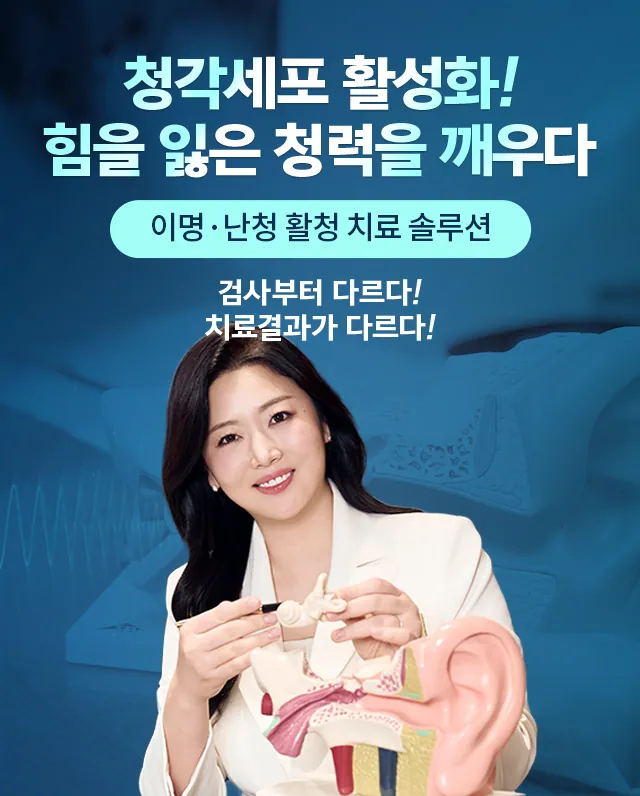
Activating Auditory Hair Cells!
Awakening Weakened Hearing
Hwalcheong care (our tinnitus and hearing loss care)
Different right from the evaluation phase!
Different in treatment results!
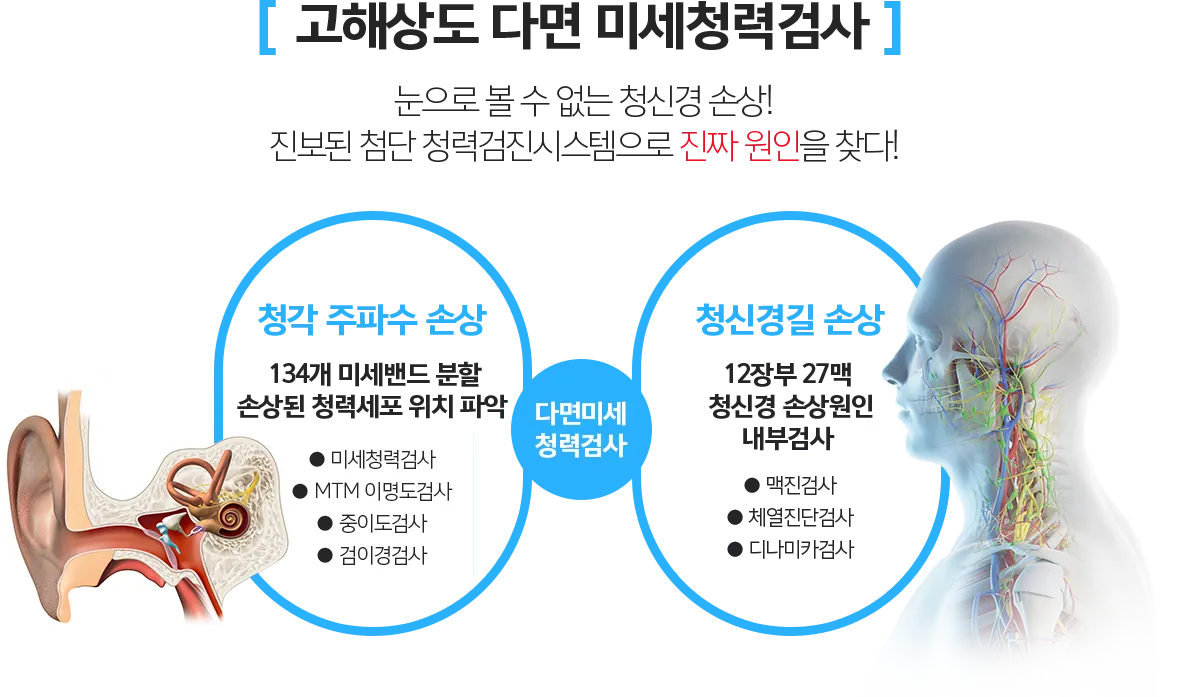
[ High-Resolution Multi-Dimensional Detailed Hearing Test ]
Auditory nerve damage invisible to the naked eye!
Finding the real cause with an advanced hearing examination system!
Multi-Dimensional Detailed Hearing Test
Auditory Frequency Damage
Division into 134 fine frequency bands
Identifying the location of damaged auditory hair cells
Auditory Nerve Pathway Damage
Internal evaluation of auditory nerve damage causes based on the 12 Zang-Fu organs and 27 pulse conditions
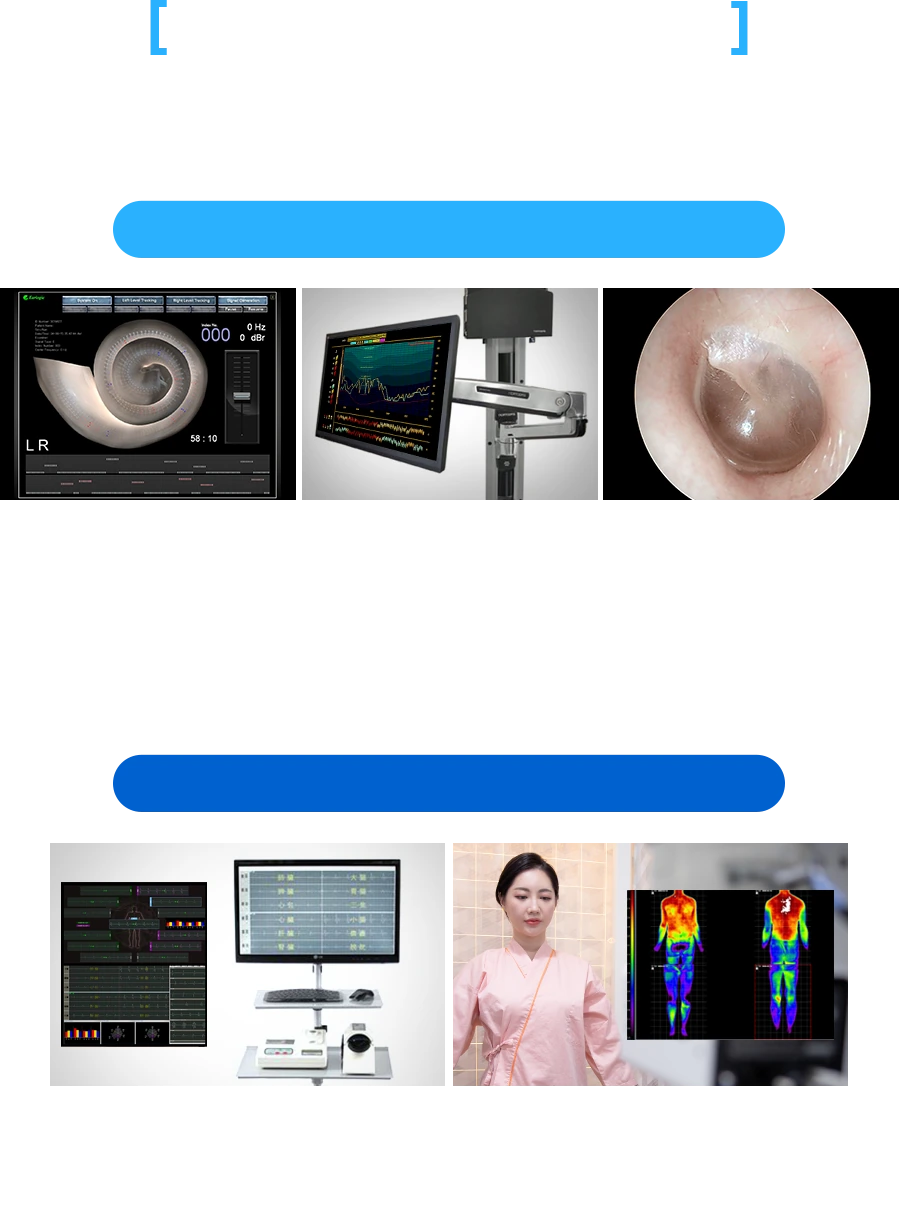
Step-by-Step Precision Hearing Tests
Proper care starts with
finding the cause accurately.
[Step 1] Identifying affected hearing frequencies
Precision audiometry
(AMA-PTA)
Pure-tone hearing test with up to 134 bands
to find the frequency ranges of hearing loss
MTM tinnitus test
Using a threshold signal modulator (MTM)
to locate the tinnitus and its masking point
Otoscopy
Checking the ear canal for structural
abnormalities with a scope
[Step 2] Checking internal factors in auditory nerve damage
Pulse diagnosis
Looking for causes of auditory nerve damage
through the flow of qi and blood in the organs
Infrared thermography
Checking circulation around the ear and
reduced body function through body heat

[ Ebian Korean Medicine Clinic, visited from across Korea ]
Visit Guide for Patients from Afar
Weekday evening hours and Sunday hours
Ebian Korean Medicine Clinic
Weekday
evening hours
Sunday priority
booking for patients
from afar
Pre-visit call
to shorten
waiting time
※ When booking, please tell us you are a 'patient visiting from afar'.

[ How Sound-Based Auditory Rehabilitation Works ]
Weakened hearing is closely linked to the activity of auditory hair cells.
Weakened hair cells
Healthy hair cells
When sound is detected, auditory hair cells move and send hearing signals to the brain.
Sound-based rehabilitation aims to support the movement and elasticity of stiffened hair cells
so that hearing-signal transmission can be supported.
Damaged
auditory hair cells
Supporting
motility and elasticity
Supporting
nerve signal transmission
Sound rehabilitation
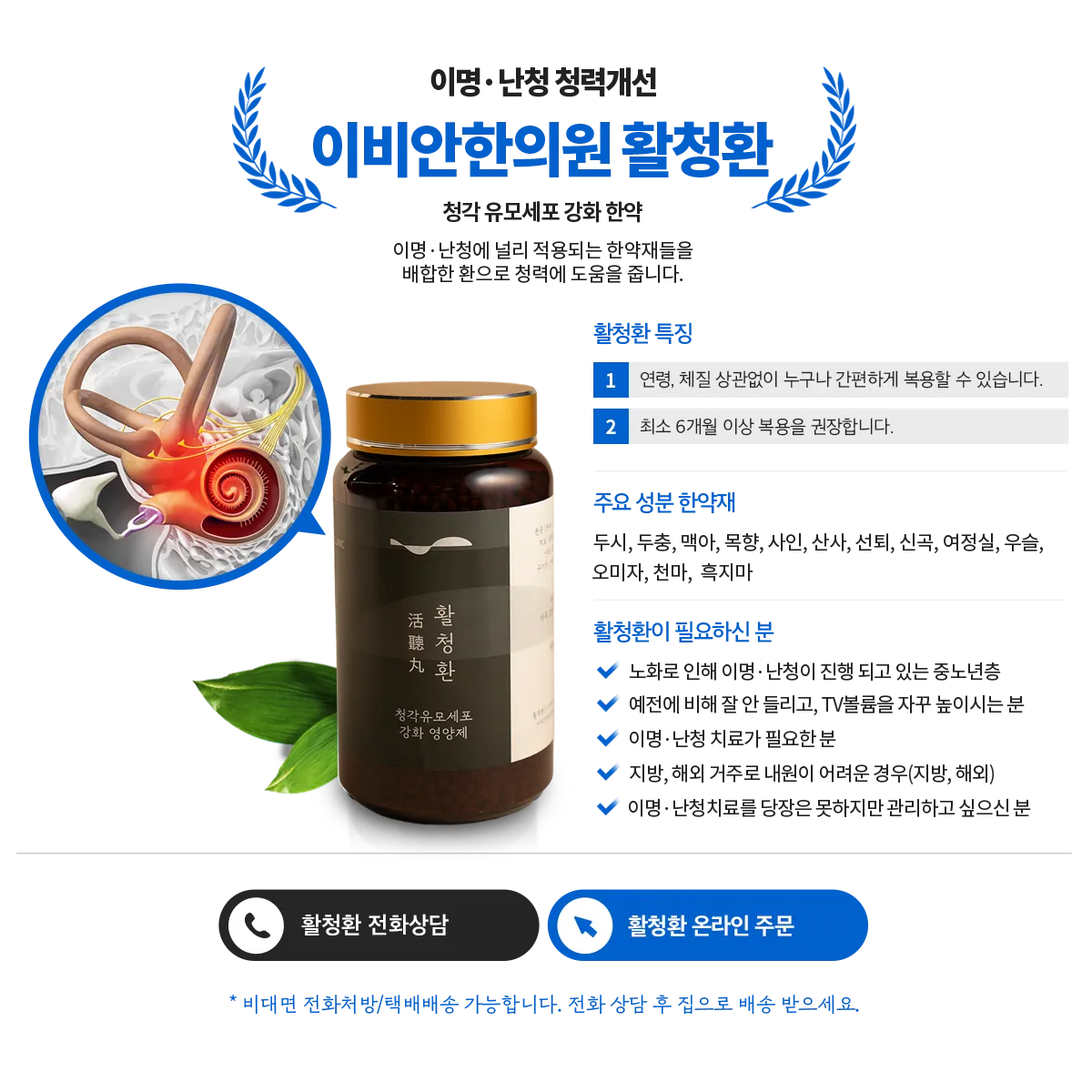
Improving Hearing in Tinnitus and Hearing Loss
Ebian Korean Medicine Clinic Hwalcheong-hwan
Korean herbal medicine for strengthening auditory hair cells
Formulated into herbal pills combining ingredients widely used for tinnitus and hearing loss, helping support hearing.
Auditory hair cell strengthening supplement
Features of Hwalcheong-hwan
Key Herbal Ingredients
Dusi (fermented soybean), Duchung (Eucommia bark), Maega (barley malt), Mokhyang (Aucklandia root), Sain (Amomum fruit), Sansa (hawthorn fruit), Seontoe (cicada slough), Singok (medicated leaven), Yeojeongsil (Ligustrum fruit), Useul (Achyranthes root), Omija (Schisandra fruit), Cheonma (Gastrodia tuber), Heukjima (black sesame)
Recommended For
* Remote phone prescription and courier delivery are available. Receive delivery at home after a phone consultation.

Who Sound Rehabilitation Is For
Just as stiff muscles are helped by rehabilitation, sound stimulation is used to help support damaged hair cells.
Tinnitus
A condition in which a certain noise is heard
'only in your own ear' due to auditory cell damage.
Tinnitus is the sensation of hearing sound
even though there is no external sound stimulus.
Hearing loss
A state in which the auditory cells and nerve pathway weaken
and sounds become hard to hear.
It often follows exposure to loud noise, fatigue,
aging, or stress, leading to hearing loss,
and is often accompanied by tinnitus.
Sudden hearing loss
Hearing drops suddenly and sharply
without a clear cause.
It most often affects one ear.
It is often accompanied by tinnitus,
a feeling of fullness in the ear, or dizziness.
Supporting auditory cells,
caring for weakened hearing.
Hwalcheong Care
Tinnitus and hearing loss are linked to auditory nerve damage.
We look for the factors that interfere with nerve signals to the brain.
Care goal – supporting the damaged hearing-signal system
Supporting auditory cell activity
Hwalcheong-tang
Supporting weakened hair cells
Sound rehabilitation
Supporting nerve signal transmission
Hwalcheong external therapy
Hwalcheong care for tinnitus and hearing loss aims to support auditory cells and the nerve pathway that carries hearing signals.
It is designed to support the activity and renewal of auditory cells.
It works on the auditory cell system that collects outside sound and carries it to the brain, and plays specific tones to hair cells with reduced activity
to support their motility and elasticity, with the aim of helping hearing.

If you believe tinnitus and hearing loss are incurable,
do not give up on treatment.

Hwalcheong-tang
Supporting auditory cell activity
Hwalcheong-tang is a herbal medicine prescribed one-to-one, intended to support auditory hair cells and the transmission of weakened hearing signals.
It is designed to supply neurotrophic support for auditory cells and to support the function of the internal organs.
At the same time, it aims to rebalance the weakened flow of qi and blood as part of managing tinnitus and hearing loss.
Sound rehabilitation
Supporting weakened hair cells
After a precision hearing test, we identify where the auditory cells are affected.
Patients listen for 30 minutes to 1 hour a day to sound waves from a sound generator matched to their threshold level,
a rehabilitation approach that aims to help slow hearing decline. Specific tones are played to auditory (hair) cells with reduced activity
to support their motility and elasticity, with the aim of helping hearing.
Auditory acupuncture
Specialized acupuncture to support the auditory nerve
A specialized acupuncture method that stimulates the ear meridians and promotes circulation of qi and blood to support the auditory nerve.
Special needles are applied at acupoints related to auditory cells, together with magnetic and warm stimulation.
At acupoints that govern hearing-signal flow, magnetized needles rather than regular needles deliver magnetic and warm stimulation toward the deep auditory nerve pathway,
combining needles, magnetism, warmth, and low-frequency stimulation in one session for tinnitus and hearing loss.
Auditory nerve Chuna
Aligning the auditory nerve pathway
Care that aligns the whole face, centered on the skull, jaw joint, and cervical spine, so hearing signals can travel well to the brain.
A poor jaw joint or a misaligned cervical spine can interfere with the auditory nerve pathway and is associated with tinnitus and hearing loss.
Auditory nerve Chuna aims to correct this and support the auditory nerve pathway.
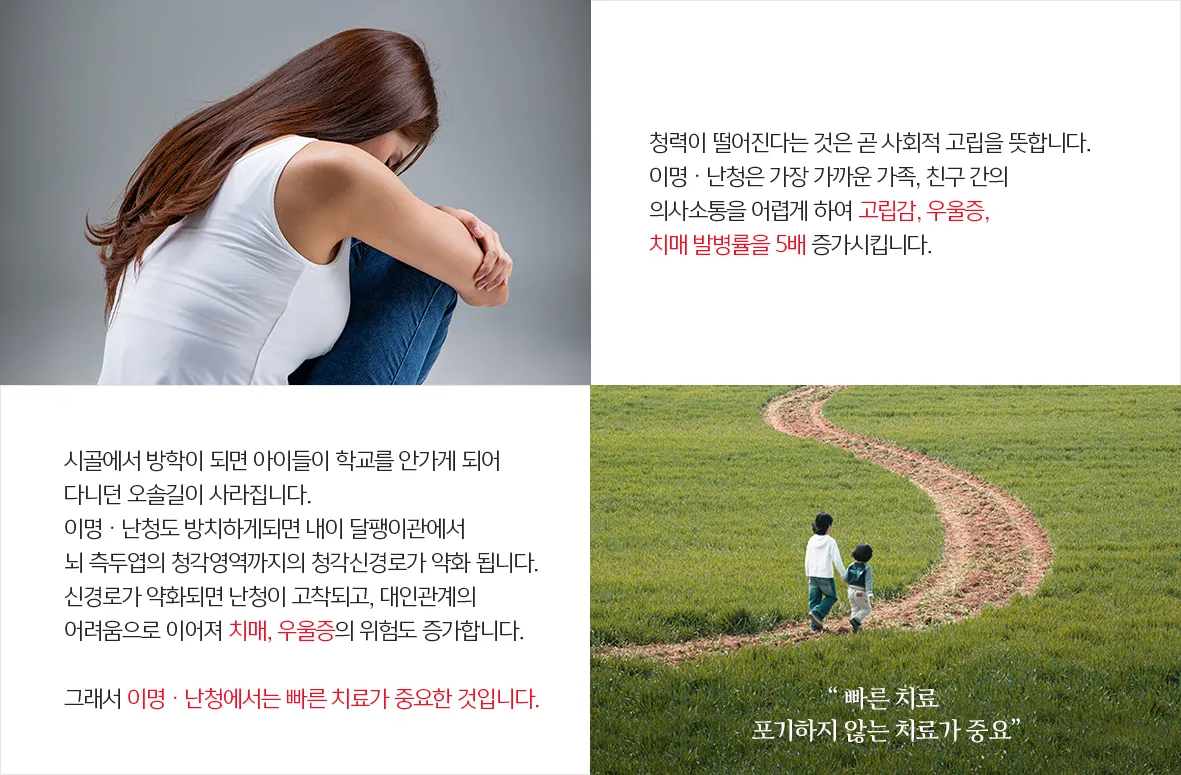
A decline in hearing means social isolation.
Tinnitus and hearing loss make communication with close
family and friends difficult, increasing the risk of
isolation, depression, and dementia by 5 times.
When school vacation starts in the countryside and children stop going to school,
the narrow footpaths they used to walk fade away.
Similarly, if tinnitus and hearing loss are left untreated, the auditory neural pathway
from the inner ear cochlea to the auditory cortex in the temporal lobe weakens.
As the neural pathway weakens, hearing loss becomes entrenched, leading to
interpersonal difficulties and increasing the risk of dementia and depression.
Therefore, prompt treatment is essential for tinnitus and hearing loss.
"Prompt treatment,
and treatment without giving up, are key"

Who Hwalcheong Care Is For
Those who want to slow the progression of hearing loss
Those whose tinnitus or hearing loss has not improved with care
Those whose brain health has declined along with their hearing
Those who also have nasal or respiratory conditions such as rhinitis or otitis media